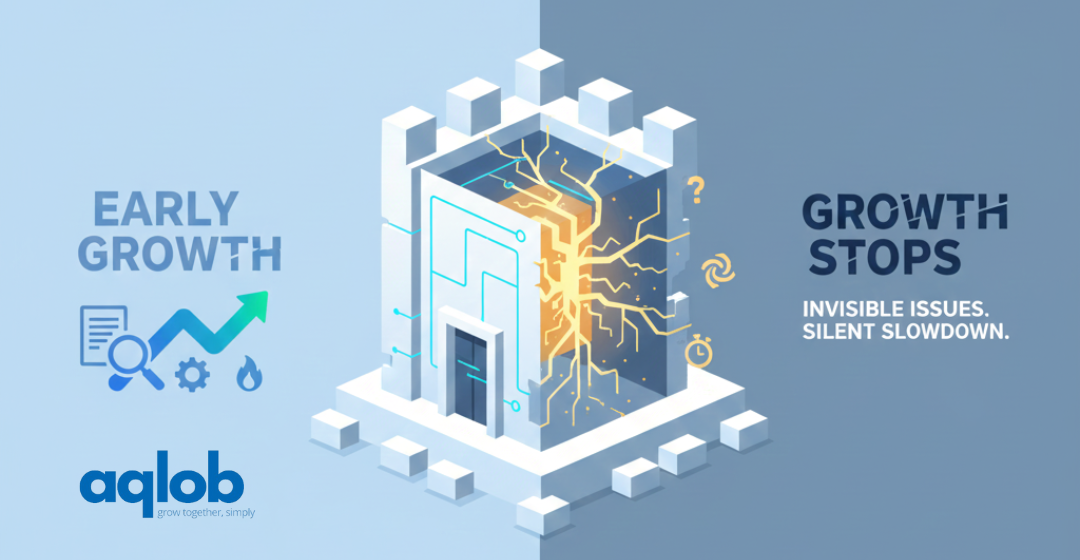
Growth Stops Quietly, Not Suddenly
Most good businesses don’t fail.
They simply slow down… almost invisibly.
And this is the real reason why good businesses stop growing — not a crisis, but a gradual loss of momentum that owners don’t notice until it becomes painful.
Revenue is coming.
Work is happening.
Clients are happy.
But momentum fades.
Opportunities slip.
And the business feels “stuck.”
Growth doesn’t stop because of one big disaster.
It stops because small cracks quietly appear inside the business — cracks that owners usually notice only when the slowdown becomes impossible to ignore.
This is the real story behind most growth plateaus.
When You Lose Sight of What’s Happening Inside the Business
In the early days, the owner sees everything clearly.
Every order.
Every purchase.
Every customer issue.
Every rupee in and out.
But as the business grows, information spreads across people, WhatsApp chats, notebooks, Excel files, and memory.
Slowly, clarity breaks.
Not because the owner isn’t capable —
but because it’s impossible for one person to track everything once the business reaches a certain size.
That’s when decisions start taking longer.
That’s when doubts replace confidence.
That’s when intuition becomes guesswork.
And without real clarity, growth quietly slows — and this is exactly why good businesses stop growing over time.
When Teams Work Hard — But Everyone Works in a Different Direction
This is one of the most silent killers of momentum.
Your team is busy.
Sometimes busier than ever.
But busyness is not growth.
Growth happens only when everyone is aligned.
And alignment breaks the moment information breaks.
One small miscommunication and:
- Sales commits something production wasn’t ready for
- Production finishes something that stores can’t dispatch
- Accounts is following an outdated timeline
- Purchases orders material that wasn’t needed yet
No one is wrong.
Everyone is trying hard.
But the business starts moving like a vehicle where each wheel turns at a different speed.
It moves — but doesn’t move forward.
This friction is invisible, but extremely expensive.
It drains time, energy, and customer trust without making any noise.
When the Business Becomes a Cycle of Firefighting
A growing business without structured visibility reaches a dangerous point:
Every day starts with fixing yesterday.
- A customer is waiting for delivery
- A follow-up was missed
- A material wasn’t ordered
- A payment wasn’t collected
- A decision was delayed
Firefighting becomes the default mode.
Everyone is reacting.
No one is planning.
And when a business spends all its energy fixing daily issues…
there’s no energy left to chase bigger goals.
Firefighting doesn’t stop growth —
it suffocates it.
When Decisions Depend on Memory Instead of Real Numbers
This is where most good businesses silently hit the ceiling.
As processes become complex, decisions become heavier.
And when information isn’t centralized or up-to-date, owners begin relying on:
“I think…”
“Maybe…”
“Last time it was like this…”
“We’ll figure it out…”
This uncertainty causes:
- Slower decisions
- Wrong decisions
- No decisions
And growth dies in the absence of confident decision-making.
A business grows as fast as the owner’s clarity.
When clarity drops, growth drops.
Conclusion — Growth Comes Back When Clarity Comes Back
Every good business that slows down has one common root cause:
It outgrows the way it is managed.
But nobody notices it in time.
The good news?
This plateau is not permanent.
Growth restarts the moment the business regains:
- Clear visibility
- Team alignment
- Smooth operations
- Confident decision-making
These are structural problems every growing business faces eventually.
And in the next blog, we’ll reveal:
“How Growing Businesses Can Get Their Clarity Back — A Practical, Step-by-Step Guide.”